Market Snapshot
Key Takeaways
Market Overview & Analysis
Report Summary
The United States used car market report provides a comprehensive analysis of the retail, wholesale, and institutional sale of pre-owned vehicles across the American automotive ecosystem. The scope covers all used passenger cars, SUVs, crossovers, pickup trucks, and light commercial vehicles transacted through franchise dealerships, independent dealer lots, online platforms, certified pre-owned (CPO) programmes, wholesale auctions, and private-party sales. The market is segmented across seven dimensions: by body type (sedan, SUV/crossover, pickup truck, hatchback, MPV), by fuel type (gasoline, diesel, hybrid, battery electric), by sales channel (offline dealership, online platform), by vendor type (organised/franchise dealers, independent/unorganised lots), by vehicle age (below 3 years, 3–5 years, 5–8 years, above 8 years), by price band (under USD 10,000; USD 10,001–30,000; above USD 30,000), and by state/region. The study covers 2021–2030, with 2025 as the base year.
The American used car market is the world’s largest by value and volume, accounting for approximately 33–35% of global pre-owned vehicle transactions. It represents roughly half of the total US automotive retail market. Used-vehicle sales consistently outpace new-vehicle sales at a ratio of approximately 2:1 by volume. The market’s structural dynamics are driven by three interconnected forces: the widening new-versus-used price gap (now exceeding USD 16,000 on average), the cyclical recovery of off-lease and trade-in supply, and the digital transformation of the retail channel from a physical-showroom-dominated model toward omnichannel integration.
The US pre-owned vehicle market in early 2026 is characterised by a supply-constrained rather than demand-led dynamic. Industry estimates indicate that February 2026 retail used sales improved to approximately 1.4 million units (+5–6% YoY), yet dealer inventory remained relatively tight at approximately 2.1 million units (about 42 days’ supply). On the wholesale side, leading used-vehicle value indices rose approximately 4% year over year in February 2026, indicating that dealer acquisition costs remain firm even as advertised retail prices softened slightly. This retail-wholesale divergence typically signals sustained demand and limited supply elasticity.
Market Dynamics
Key Drivers
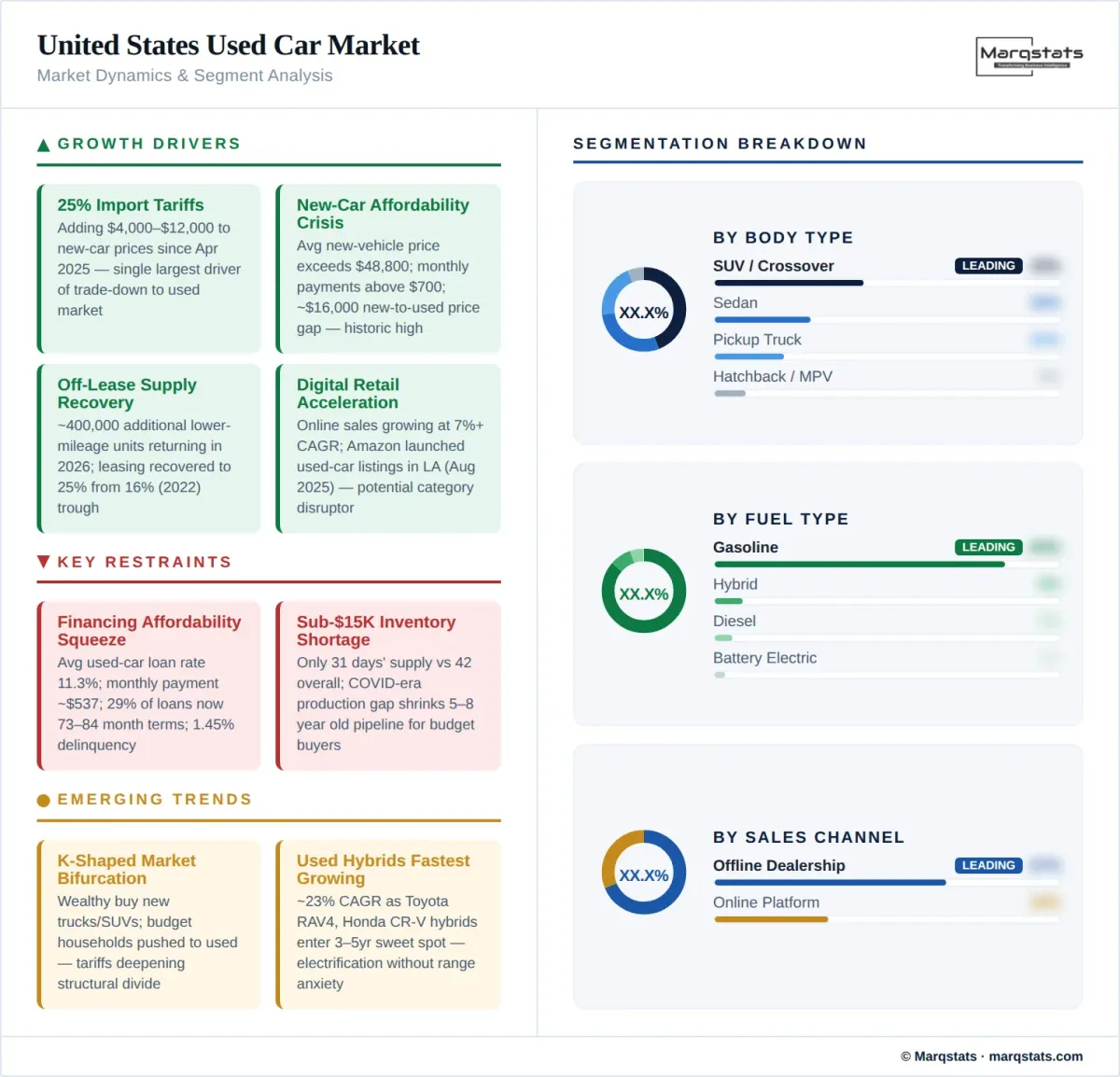
- Tariff-driven new-vehicle price inflation accelerating trade-down: The 25% tariffs on imported automobiles, effective since April 2025, are the single largest demand accelerant for the US used car market. Industry analyses estimate the tariffs add USD 4,000–12,000 to new vehicle sticker prices depending on the origin and assembly location. Average new-vehicle transaction prices exceeded USD 48,800 in 2025, with monthly payments above USD 700. This affordability squeeze is steering first-time buyers, young households, and budget-conscious consumers toward used vehicles. The K-shaped market dynamic — where higher-income buyers absorb new SUVs and trucks while the middle market is priced out — is widening the demand base for pre-owned vehicles.
- New-vehicle affordability crisis reaching historic levels: New-vehicle prices are at their highest nominal levels in US automotive history. One in five US buyers now faces monthly payments above USD 1,000. The approximately USD 16,000 average price gap between new and used vehicles is the widest on record. Used-vehicle loan balances averaged approximately USD 27,500 in Q4 2025, offering a substantial entry point for value-oriented shoppers. This structural affordability gradient is the market’s primary demand driver.
- Off-lease supply recovery beginning in 2026: Off-lease vehicle returns dropped from approximately 4.4 million units in 2019 to just 2.8 million in 2024, driven by COVID-era production shortages that reduced leasing penetration to only 16% by late 2022. As leasing recovered to approximately 25% of new-vehicle transactions by 2025, an estimated 400,000 additional lower-mileage off-lease units are projected to re-enter the used market in 2026. This supply influx will significantly improve the availability of 1–3-year-old CPO-eligible inventory — the most sought-after and highest-margin segment for dealers.
- Certified pre-owned (CPO) programme expansion: Industry estimates indicate approximately 2.6 million CPO units were sold in the US in 2025, up roughly 2% from 2024. CPO programmes provide OEM-backed warranties, multi-point inspections, and quality assurance that bridge the trust gap for used-car buyers. These programmes command premium pricing (typically USD 2,000–4,000 above non-certified equivalents) and generate higher per-unit margins for dealers. As off-lease supply recovers, CPO-eligible inventory will expand, further supporting segment growth.
- Digital transformation and omnichannel retail: Online used-car sales are expanding at over 7% CAGR, driven by consumer demand for transparent pricing, digital financing pre-approval, virtual vehicle tours, and home delivery. While offline dealerships still account for approximately 66–67% of transactions, leading retailers have adopted omnichannel strategies integrating digital discovery with showroom closing. Amazon launched used and certified vehicle listings in Los Angeles in August 2025 with plans for national expansion — a potentially disruptive entry leveraging unmatched logistics infrastructure and consumer trust.
Key Restraints
- Used-vehicle financing affordability squeeze: Average used-vehicle loan rates reached approximately 11.3% in Q4 2025, with average monthly payments at approximately USD 537. The share of used-vehicle loans with 73–84-month terms rose to approximately 29%, reflecting consumers stretching payments to manage monthly budgets. Subprime borrowers (approximately 22.5% of financed used-vehicle deals in Q4 2025) face even higher rates, exceeding 16% in some cases. Auto loan delinquencies (60+ days past due) stood at approximately 1.45% in Q3 2025. These credit constraints cap the effective demand base despite strong purchase intent.
- Tight inventory at the affordable end: Vehicles priced below USD 15,000 had only approximately 31 days’ supply in February 2026, versus 42 days for the overall market. This acute shortage of budget-tier inventory means the segment where demand is most intense is also where supply is most constrained. The COVID-era production gap reduced the pipeline of vehicles now entering the 5–8-year-old bracket, concentrating value-seeking buyers in a thin inventory pool.
- Dealer margin compression: Average dealer gross profit per used unit dropped approximately 9% year over year to roughly USD 1,300 in 2025. The combination of rising acquisition costs at wholesale auction (where leading value indices were up approximately 4% YoY in February 2026) and consumer price sensitivity on the retail side is squeezing dealer economics. Higher reconditioning costs and longer inventory hold times in the premium segment add further margin pressure.
- Used EV resale uncertainty and federal credit expiry: Used battery-electric vehicles represent less than 3% of total used-car inventory but face unique challenges. The federal used-EV tax credit expired at the end of 2025, removing a key demand incentive. Accelerating new-EV depreciation (with some models losing 25–30% of value in the first year) and consumer concerns about battery health, non-homeowner charging access, and range anxiety moderate near-term used-EV demand growth despite falling price points.
Key Trends
- K-shaped market bifurcation: The US auto market is increasingly K-shaped — higher-income households purchase new trucks, SUVs, and luxury vehicles, while budget-constrained buyers are funnelled into the used market. This structural bifurcation is deepening as tariffs inflate new-vehicle prices further. The effect is visible in segment-level demand: used SUVs/crossovers and pickup trucks are experiencing strong demand, while sedans face slower turn rates at dealerships.
- Wholesale-retail price divergence signalling supply tightness: In early 2026, leading wholesale used-vehicle value indices rose approximately 4% year over year even as dealer listing prices eased slightly. This divergence typically indicates that dealers face firm acquisition costs at auction while being forced to moderate retail asking prices due to consumer credit constraints. The implication is a margin squeeze that rewards high-volume, low-cost operators and penalises capital-constrained independent lots.
- Reconditioning infrastructure as competitive moat: Leading used-vehicle retailers are investing heavily in reconditioning capacity to accelerate inventory throughput and improve per-unit economics. Major online retailers are converting wholesale auction facilities into mega-reconditioning sites (10–12 facilities planned), while large franchise dealer groups are building centralised reconditioning hubs. This infrastructure investment creates scale advantages and barriers to entry for smaller operators.
- Amazon Autos entry as potential category disruptor: Amazon launched used and certified vehicle listings in Los Angeles in August 2025 with plans for national expansion. The entry leverages Amazon’s logistics network, consumer trust, Prime ecosystem, and digital payments infrastructure. While early-stage, Amazon’s track record of disrupting adjacent retail categories (grocery, pharmacy, financial services) makes this the most closely watched competitive development in used-car retail.
- Used hybrid vehicles as the fastest-growing fuel segment: Hybrid used vehicles are expanding at approximately 23% CAGR, driven by consumer preference for fuel economy without range anxiety. As new hybrid models proliferate and early-generation hybrids enter the 3–5-year-old sweet spot, the used hybrid segment is attracting buyers who want electrification benefits without battery-health uncertainty.
Market Segmentation
SUVs and crossovers dominate the US used car market with approximately 43% share in 2025, making this the largest and fastest-growing body type segment. Consumer preference for higher ride height, cargo capacity, and all-weather capability drives sustained demand. Popular used models include Toyota RAV4, Honda CR-V, Ford Explorer, Chevrolet Equinox, and Jeep Grand Cherokee. The segment benefits from strong residual values and broad appeal across demographics.
Sedans retain a significant but declining share of the used market as new-model production shifts toward SUVs and trucks. Used sedans remain important for budget-conscious buyers seeking lower purchase prices and better fuel economy. Popular models include Toyota Camry, Honda Civic, Honda Accord, Nissan Altima, and Hyundai Elantra. The segment faces longer turn times at dealerships compared to SUVs.
Pickup trucks command premium pricing in the used market, with strong demand driven by Sunbelt population migration (Texas, Florida, North Carolina), construction activity, and lifestyle preferences. Used Ford F-150, Chevrolet Silverado, RAM 1500, Toyota Tacoma, and GMC Sierra are consistently among the most-searched used vehicles. The segment benefits from exceptional residual value retention.
Gasoline vehicles retain approximately 84% of the US used car market share in 2025, reflecting the overwhelming dominance of internal combustion in the existing vehicle fleet. This share is declining gradually as hybrid and electric vehicles enter the used supply pipeline, but the pace of transition is moderated by the fleet’s 12.5-year average age and the concentration of EV adoption in newer model years.
Used hybrid vehicles are the fastest-growing fuel segment at approximately 23% CAGR, driven by consumer preference for fuel economy without range anxiety. As Toyota Prius, RAV4 Hybrid, Honda CR-V Hybrid, and Ford Escape Hybrid models from 2020–2023 enter the 3–5-year-old used sweet spot, supply is expanding to meet growing demand. Hybrid vehicles offer a middle ground that appeals to electrification-curious buyers who are not ready for full battery-electric ownership.
Used battery-electric vehicles represent less than 3% of total used-car inventory but are growing rapidly as Tesla Model 3, Model Y, Nissan Leaf, and Chevrolet Bolt enter the used supply. Accelerating new-EV depreciation (25–30% first-year value loss for some models) has brought many used EVs into the USD 20,000–28,000 range, attracting budget buyers in coastal metros with mature charging networks. However, the federal used-EV tax credit expiry at end of 2025 and consumer concerns about battery degradation and non-homeowner charging access are moderating near-term demand growth. California’s Advanced Clean Cars II mandate requiring 35% zero-emission new-vehicle sales by 2026 is prompting a rush of gasoline trade-ins that may temporarily depress residual values in the West Coast market.
Offline dealerships account for approximately 66–67% of used-vehicle transactions in 2025, reflecting continued consumer preference for physical vehicle inspection, test drives, and in-person negotiation. Franchise dealer groups and large independent chains are investing in omnichannel integration — combining online inventory browsing, digital financing pre-approval, and home delivery with traditional showroom experiences. The pure-play online model’s limitations were validated by the market exits of major digital-only retailers in 2023, demonstrating that consumers still value physical touchpoints.
Online used-car sales are expanding at over 7% CAGR, driven by transparency demands, digital financing, virtual tours, and contactless delivery. Leading online retailers have demonstrated the model’s viability: the second-largest US used-vehicle retailer reported 143,000+ retail units in Q2 2025 (+41% YoY) with positive operating margins. Amazon’s August 2025 entry into used-car listings in Los Angeles, leveraging its logistics and Prime ecosystem, signals the next phase of digital disruption. The online channel is increasingly integrated with physical infrastructure (reconditioning centres, delivery hubs) rather than operating as a standalone digital-only model.
By Geography
California
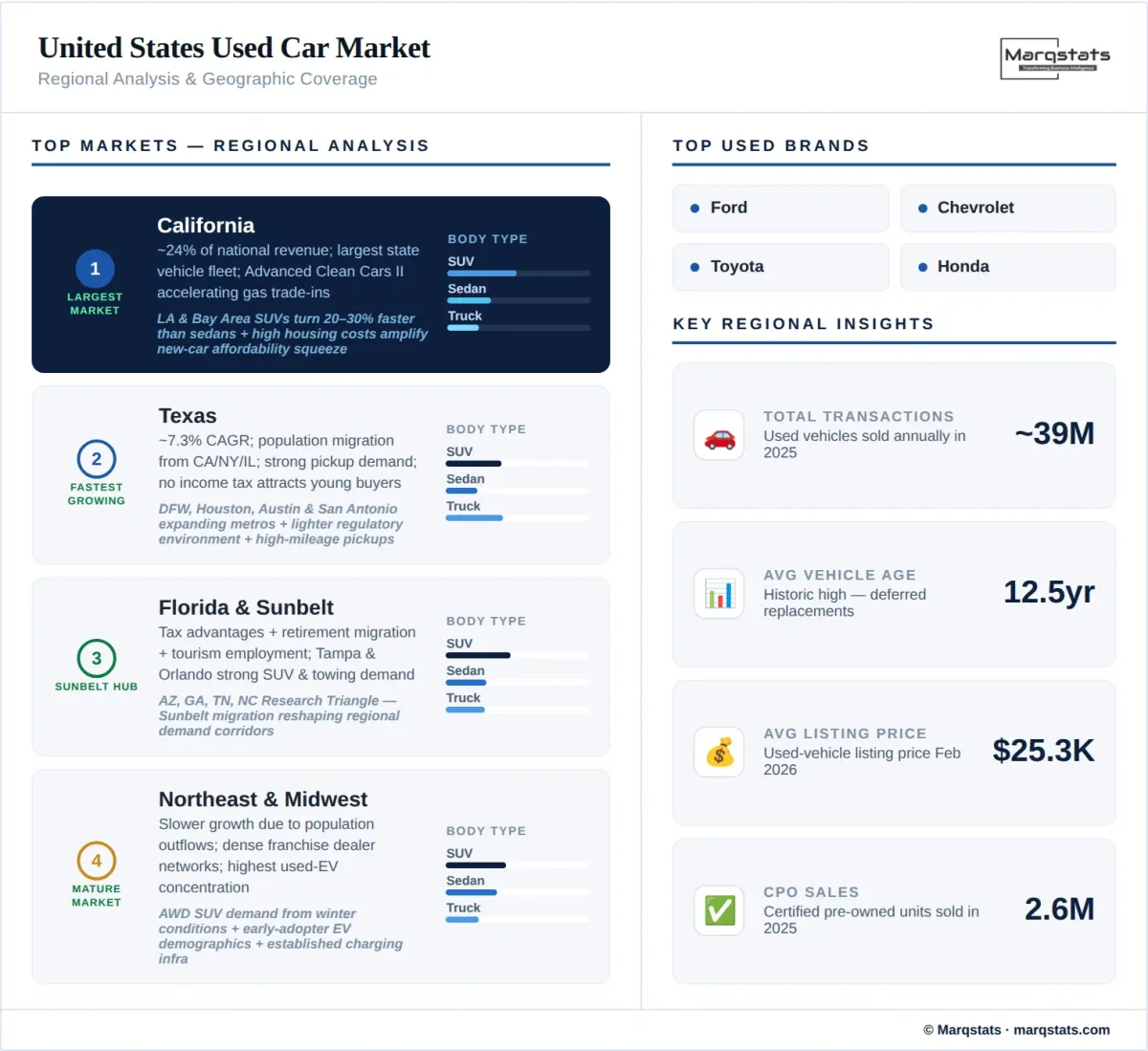
California leads the US used car market with approximately 24% of national revenue, driven by population scale, the largest state vehicle fleet, and aggressive clean-air mandates. Advanced Clean Cars II requiring 35% zero-emission new-vehicle sales by 2026 is accelerating gasoline vehicle trade-ins, expanding used-car supply in the short term but potentially depressing gasoline residual values. Los Angeles and the Bay Area show SUVs turning 20–30% faster than sedans. The state’s high housing costs amplify the new-vehicle affordability squeeze, pushing more households toward pre-owned options.
Texas
Texas is the fastest-growing state market at approximately 7.3% CAGR, fuelled by population migration from higher-cost states (California, New York, Illinois), lighter regulatory requirements, strong pickup truck demand, and expanding metro areas (Dallas-Fort Worth, Houston, Austin, San Antonio). Texas dealers comfortably retail higher-mileage pickups that would face challenges in emissions-strict regions. The state’s no-income-tax environment attracts young professionals and families who represent core used-vehicle demand.
Florida and the Sunbelt
Florida captures buyers drawn by tax advantages, retirement migration, and year-round tourism employment. Tampa and Orlando show strong demand for family SUVs and towing-capable vehicles. North Carolina’s Research Triangle supports late-model used-car sales through technology and pharmaceutical sector hiring. The broader Sunbelt migration pattern (Texas, Florida, Arizona, Georgia, Tennessee) is reshaping regional demand corridors and favouring states with lower regulatory burdens and growing working-age populations.
Northeast and Midwest
Mature Northeastern markets (New York, New Jersey, Massachusetts) and Midwest states face slower used-car market growth, constrained by population outflows, higher regulatory burdens, and elevated cost of living. However, these regions remain significant by absolute volume and feature denser franchise dealer networks. Winter conditions support demand for AWD SUVs and all-season-capable vehicles. The Northeast also has the highest concentration of used-EV transactions due to early-adopter demographics and established charging infrastructure.
How Competition Is Evolving
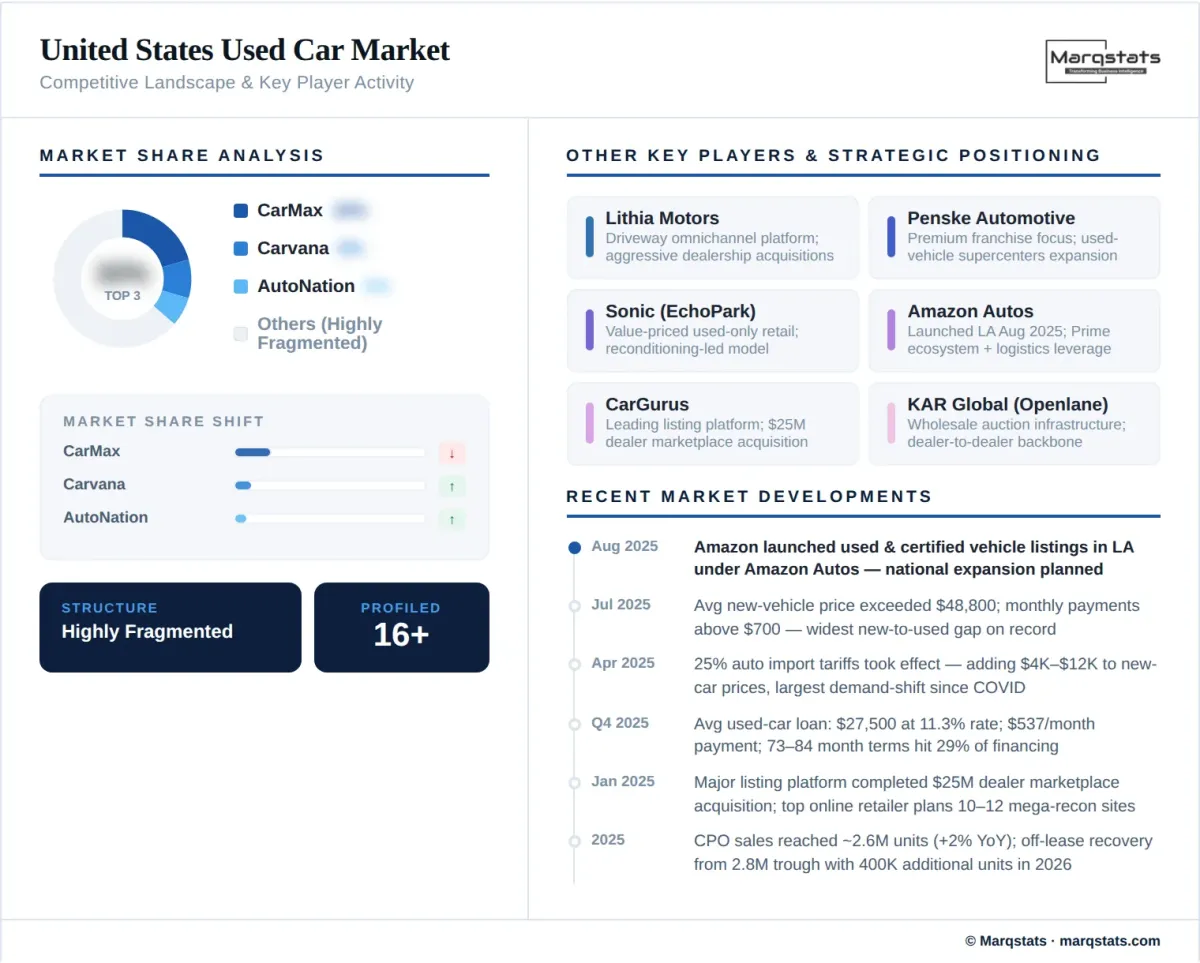
The US used car market is defined by a diverging competitive landscape. The largest used-vehicle retailer sold approximately 766,000 units in its most recent fiscal year and is pursuing an omnichannel strategy integrating digital financing with showroom experiences. The second-largest has emerged as the market’s breakout performer: reporting 143,000+ retail units in Q2 2025 (+41% YoY), positive GAAP operating margins exceeding 10%, and significant stock appreciation — validating its end-to-end online model and reconditioning infrastructure investments. In contrast, two prominent pure-play online retailers exited the market in 2023, demonstrating that consumers still value physical vehicle inspection and that digital-only models face structural challenges in a high-consideration-purchase category.
Amazon launched used and certified vehicle listings in Los Angeles in August 2025, with plans for national expansion — the most closely watched competitive development in the sector. Major franchise dealer groups are investing in centralised reconditioning hubs and omnichannel platforms. Leading wholesale auction operators and listing platforms continue to consolidate the dealer-to-dealer transaction layer. A major listing platform acquired a wholesale exchange business, while another completed a USD 25 million dealer marketplace acquisition in January 2025. The competitive landscape is evolving from traditional inventory-and-showroom competition toward a platform-and-logistics arms race, where reconditioning throughput, digital customer acquisition costs, and financing integration determine market share.
The certified pre-owned (CPO) segment represents a significant competitive arena, with OEM-backed programmes (Toyota CPO, Honda CPO, Ford Blue Advantage, GM’s manufacturer-backed used-car brand) competing against dealer-group proprietary certification programmes. CPO units typically command USD 2,000–4,000 premiums over non-certified equivalents and generate higher per-unit margins, making programme scale a competitive differentiator. Industry estimates place 2025 US CPO sales at approximately 2.6 million units, up roughly 2% from 2024. In February 2026, CPO sales were estimated at approximately 207,000 units, up about 2% year over year.
Companies Covered
The report profiles 16+ companies with full strategy and financials analysis, including:
Recent Market Activity
Table of Contents
Coverage & Segmentation
This report provides a comprehensive analysis of the United States used car market covering 2021–2030, with 2025 as the base year, historical data from 2021 to 2025, and forecast projections from 2026 to 2030. The study examines market size (in USD billion and unit volumes), growth trends, competitive landscape, and segment-level forecasts across seven dimensions: by body type (sedan, SUV/crossover, pickup truck, hatchback, MPV), by fuel type (gasoline, diesel, hybrid, battery electric), by sales channel (offline, online), by vendor type (organised, independent), by vehicle age (below 3 years, 3–5, 5–8, above 8), by price band (under USD 10K, USD 10–30K, above USD 30K), and by state/region (California, Texas, Florida, North Carolina, Northeast, Midwest, and others).
The analysis covers the complete value chain from wholesale acquisition (auction channels, trade-ins, off-lease returns) through reconditioning, retail, and financing. The report tracks used-vehicle pricing dynamics through leading wholesale value indices and retail listing price data. Primary data sources include Bureau of Labor Statistics CPI data, Bureau of Economic Analysis auto sector reports, Federal Reserve and Experian auto lending data, FHFA and state DMV registration records, industry trade publications, and proprietary primary research with dealers, wholesale operators, and auto lending executives. Note: The market size estimate of USD 870 billion (2025) to USD 1.05 trillion (2030) is a Marqstats proprietary projection; published third-party estimates vary materially.


